News & articles
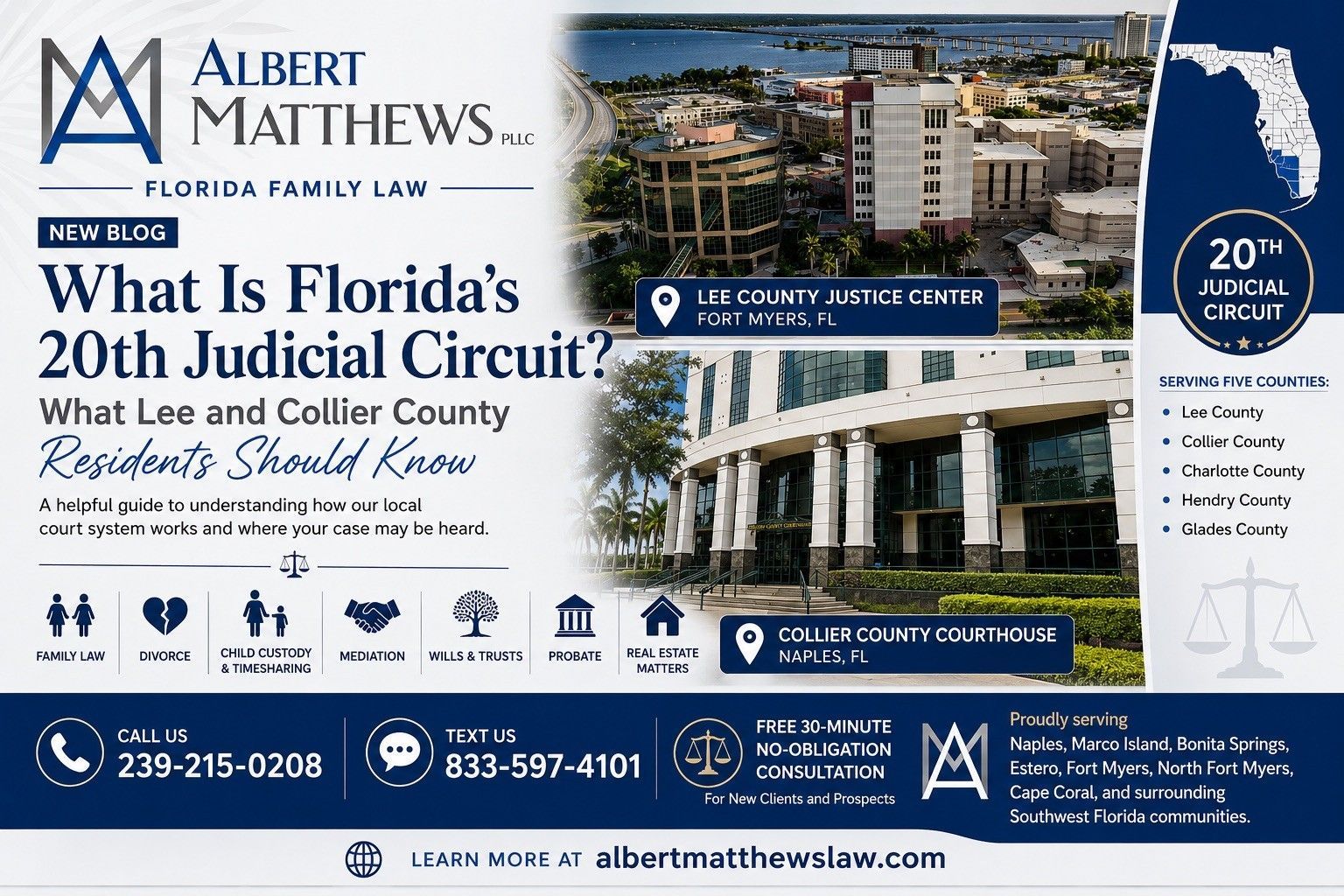
What Is Florida’s 20th Judicial Circuit? What Lee and Collier County Residents Should Know
If you live in Lee or Collier County and become involved in a legal matter, you may hear the term “20th Judicial Circuit.” But what exactly does that mean, and how does it affect where and how your case is handled?
Understanding the local court system can make the legal process feel less confusing. Whether you’re navigating a divorce, child custody matter, probate proceeding, real estate dispute, or another legal issue, knowing how Florida’s courts are organized is a helpful place to start.
What Is a Judicial Circuit?
Florida’s court system is divided into judicial circuits that serve specific geographic areas of the state. Each circuit may include one or more counties and has circuit judges who hear cases within its jurisdiction.
Florida’s 20th Judicial Circuit includes five counties:
- Lee County
- Collier County
- Charlotte County
- Hendry County
- Glades County
For residents of Naples, Marco Island, Bonita Springs, Estero, Fort Myers, North Fort Myers, and Cape Coral, many legal matters are handled within the 20th Judicial Circuit.
What’s the Difference Between Circuit Court and County Court?
Although both operate within Florida’s court system, Circuit Courts and County Courts handle different types of cases.
Circuit Courts generally hear matters involving:
- Family law and divorce
- Child custody and timesharing
- Juvenile matters
- Probate and guardianship
- Felony criminal cases
- Civil disputes above certain jurisdictional thresholds
- Appeals from certain lower court decisions
County Courts generally handle matters such as:
- Certain civil disputes within the jurisdictional limit established by Florida law
- Small claims cases
- Misdemeanor criminal cases
- Traffic matters
- Certain landlord-tenant disputes
The type of legal issue involved typically determines which court has jurisdiction over the case.
Where Are Cases Heard in Lee and Collier Counties?
- If your case is filed in Lee County, court proceedings may take place at a Lee County courthouse facility in Fort Myers.
- If your case is filed in Collier County, proceedings may take place at the courthouse complex in Naples.
However, the correct location for a particular case can depend on the type of proceeding, the assigned judge, and other factors. Some hearings may also be conducted remotely when permitted by the court.
Always review your official court documents carefully to confirm the correct date, time, location, courtroom, and whether the proceeding will be held in person or remotely.
Why Does It Matter Where a Case Is Filed?
Where a legal action should be filed can depend on several factors, including:
- Where the parties live
- Where certain events occurred
- The type of legal matter involved
- Florida’s jurisdiction and venue requirements
For example, specific residency requirements apply to Florida divorce proceedings. Other matters, such as probate or certain real estate cases, may have different rules governing where the case should be filed.
Because every situation is different, it’s important not to assume that a case can automatically be filed in whichever county is most convenient.
What Should You Know Before Going to Court?
If you have an upcoming court appearance in Lee or Collier County, preparation is important.
Before your hearing:
- Carefully review your notice of hearing and other court documents.
- Confirm whether your appearance is in person or remote.
- Verify the courthouse location and courtroom.
- Plan to arrive early if appearing in person.
- Dress appropriately and professionally.
- Bring any documents your attorney has instructed you to have available.
- Follow all courthouse security requirements and courtroom rules.
Court procedures can vary depending on the type of case and the judge assigned to it, so following the specific instructions provided in your case is essential.
Can You Look Up Court Records Online?
Lee and Collier counties provide online access to certain court information through their respective Clerks of Court. However, not every document or case is publicly accessible. Some records may be confidential, restricted, sealed, or otherwise unavailable online.
The Clerk of Court plays an important administrative role in maintaining court records, processing filings, and supporting the operation of the court system. The Clerk does not act as your attorney and cannot provide legal advice about your specific situation.
Why Understanding Your Local Court System Matters
For many people, their first interaction with the court system happens during an already stressful time—a divorce, a dispute involving children, the death of a loved one, or another major life transition.
Understanding basic terms such as judicial circuit, jurisdiction, venue, Circuit Court, and County Court can help you feel more informed as you navigate the legal process.
At Albert Matthews Law, we believe informed clients are better prepared to ask questions, understand their options, and make decisions about their future.
Albert Matthews Law: Serving Southwest Florida
Albert Matthews Law assists individuals and families with legal matters including:
- Family Law
- Divorce
- Child Custody and Timesharing
- Parenting Plan Modifications
- Mediation
- Wills and Trusts
- Estate Planning
- Probate
- Real Estate Matters
We proudly serve clients throughout Naples, Marco Island, Bonita Springs, Estero, Fort Myers, North Fort Myers, Cape Coral, and surrounding Southwest Florida communities.
If you have questions about a legal matter or would like to discuss your circumstances with our team, we invite you to complete our Contact Us form. You can also reach our office by phone at 239-215-0208 or text us at 833-597-4101.
Albert Matthews Law offers a free 30-minute, no-obligation consultation for new clients and prospects.
This article is provided for general informational purposes only and does not constitute legal advice. Laws, court procedures, and individual circumstances may vary. Reading this article or contacting the firm does not, by itself, create an attorney-client relationship.
Related Posts